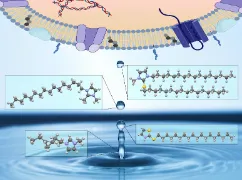
Lipid-Inspired Ionic Liquids as Versatile Bioinspired Materials: From Gene Delivery Agents to Sustainable Aviation Fuels
Nature has spent billions of years solving the problem of designing functional materials that perform reliably across extreme conditions. Our research program takes direct inspiration from these biological solutions to address one of the most persistent challenges in ionic liquid (IL) design: creating salts that are simultaneously very low-melting, highly lipophilic, and bio-innocuous — a combination of properties that conventional design strategies cannot readily achieve together.
Drawing on the molecular mechanisms of homeoviscous adaptation (HVA), whereby living organisms incorporate structural motifs such as cis-cyclopropyl groups and thioether linkages into membrane lipids to maintain fluidity under thermal stress, we have developed a rational design platform for a new class of lipid-inspired ILs. By translating these biological principles into synthetic materials, our group has produced a versatile library of functional organic-ion materials with tunable melting points, tailored lipophilicity, and promising bio-innocuity profiles. These materials have demonstrated broad utility across applications as diverse as gene delivery, lubrication, heat-transfer fluids, and separations.
Most recently, we have extended this bioinspired framework to the design of renewable high-energy-density fuel candidates, demonstrating that the same structural principles governing membrane fluidity can be harnessed to engineer ionic materials with competitive energetic performance, exceptional thermal and oxidative stability, and negligible vapor pressure. Together, these advances establish lipid-inspired ILs as a versatile and expanding materials platform at the intersection of biological design principles and applied materials chemistry.